
Through the Panama Canal
Part of sailing is record-keeping. And during our four years living aboard the good ship Atalanta, part of our records (in addition to our day-to-day ship’s logs) were the long and detailed emails that Ginny periodically sent to landlubbing friends and family to keep them up to date on this strange endeavor of ours.
Here is an excerpt from one of them, from March 20-21, 2004.
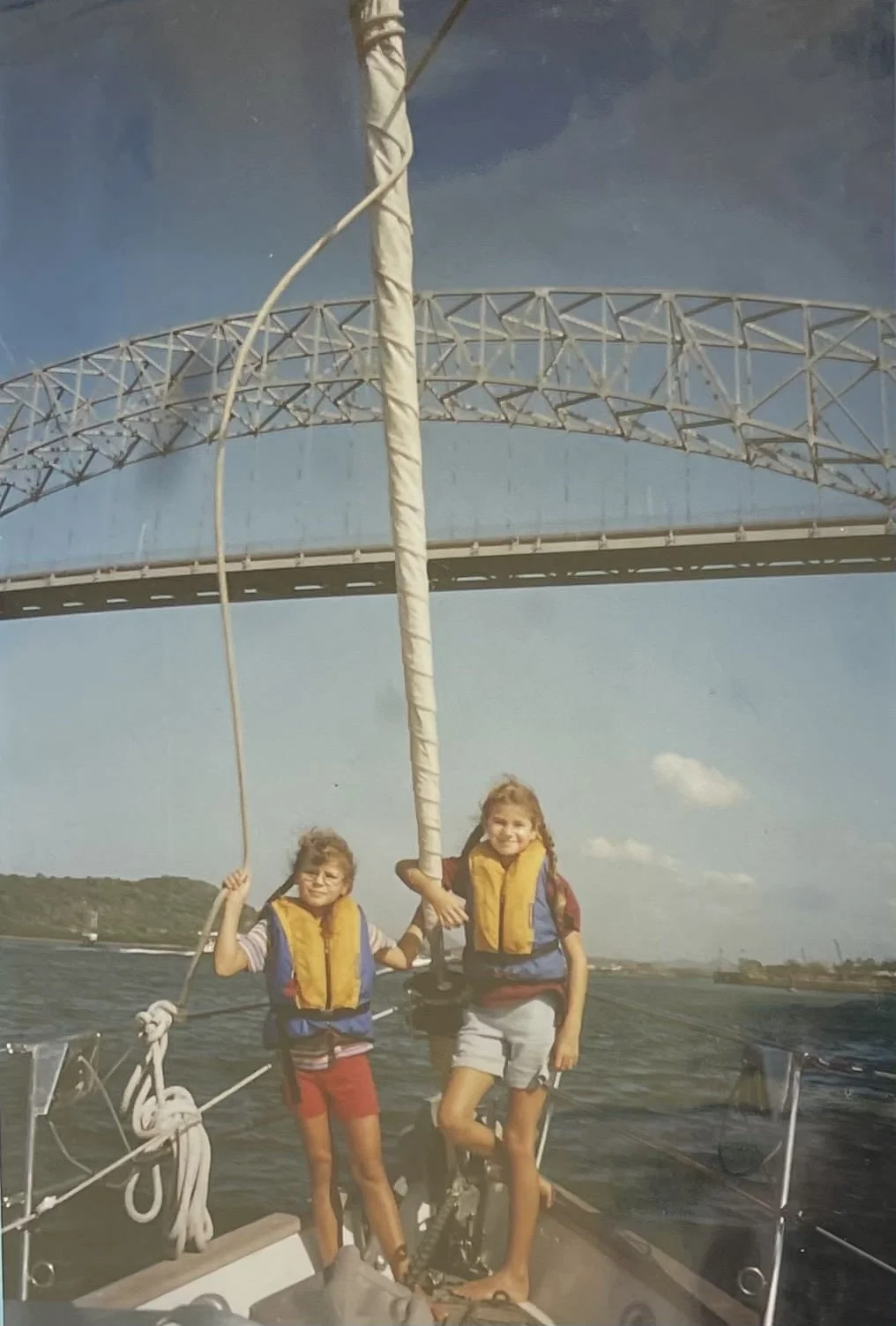
Rhiannon and Vienna as we approach the Bridge of the Americas and the Pacific end of the Panama Canal
On Saturday, March 20, at 7 AM, we were ready and waiting, crew aboard, for our canal advisor. Every boat going through is required to have a captain and 4 line handlers. Our friends Mike and Heather (of Orion), and Mike's sister Kristen were our 3 additional line handlers.
Our first scheduled lock time was 9 AM. Our advisor arrived about 20 minutes before 9, and it soon became clear that we were not going to be locking up on time. This eased my mind a bit, since if we did not make it through in one day, it could reasonably be stated that it was the fault of the canal operators for not getting us through the first lock at the scheduled time. If we required 2 days through no fault of ours, we should not be charged for the second day, a savings of $650.
As soon as our advisor was on board, it was full speed ahead for the locks. We were to be in a lock up consisting only of small boats. There were 4 powerboats, 2 tugs, a large tourist boat, Tioga, and Atalanta. Tioga rafted to Atalanta before we entered the locks. We were the last ones in, and we rafted to the tourist boat.
In spite of the way this picture is oriented, we were going from Pacific to Atlantic
Everything went smoothly and the lines were made fast. We spoke with quite a few of the tourists on that boat, and I think we will be appearing in many home videos. Unfortunately the engine exhaust of the tourist boat was right next to our cockpit! So we stood anywhere but there while the water came in and we slowly rose up in the lock.
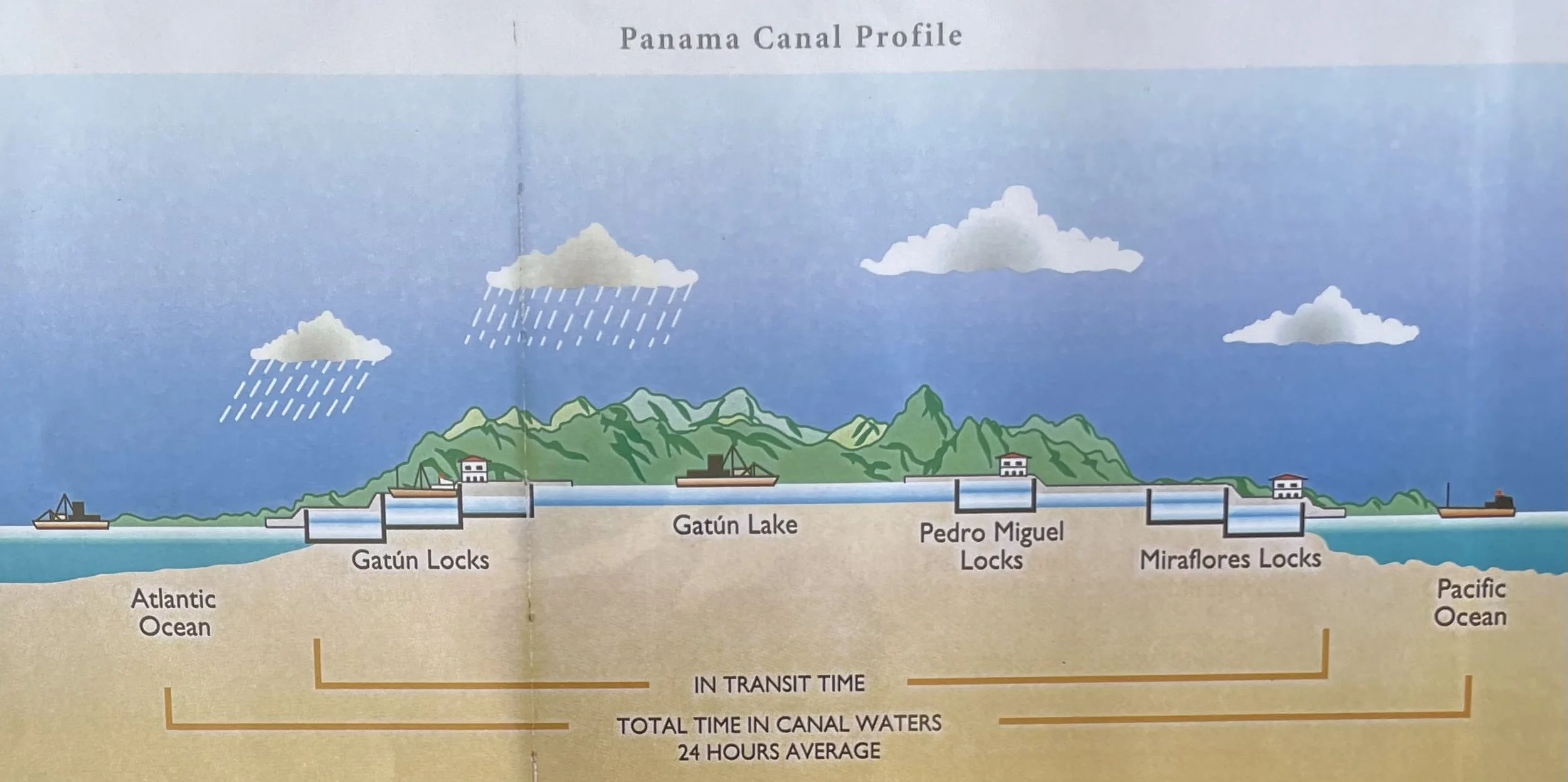
Since we were rafted to the tourist boat, and they were next to the wall, their line handlers on the wall side did all the work. The Miraflores Locks has 2 chambers, so at the top we waited for the boats in front of us to move into the second chamber, then we untied from the tourist boat and Tioga and Atalanta moved together into the 2nd chamber. The configuration was the same in the second chamber.
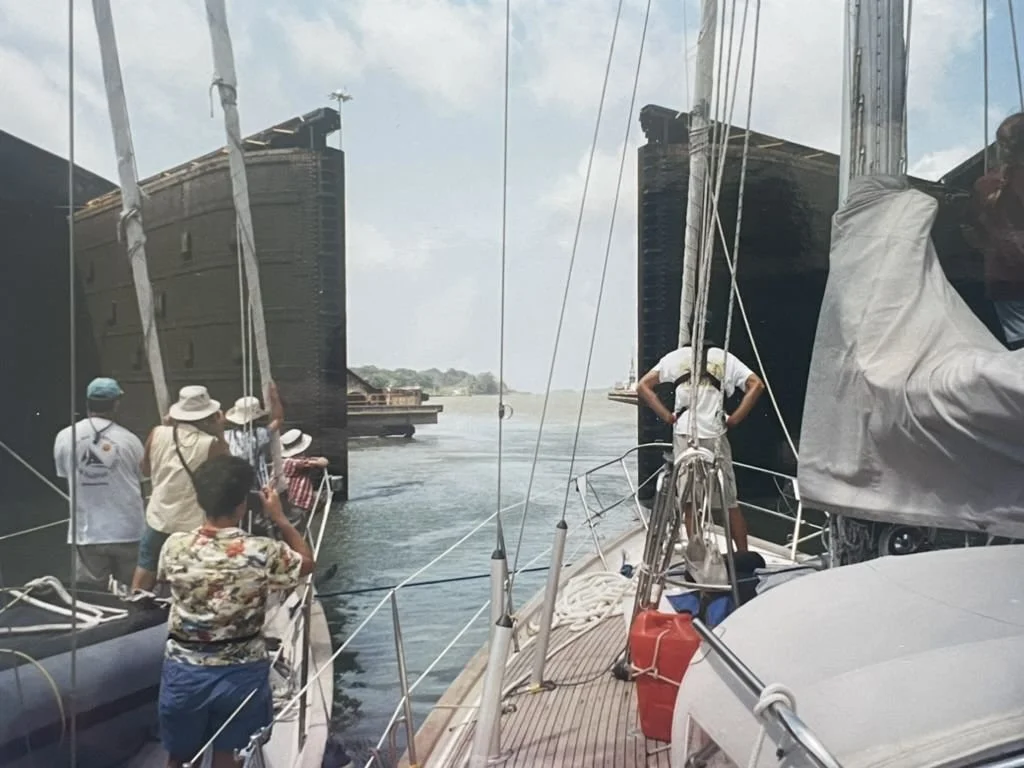
Everyone watches eagerly as the lock opens
While motoring across the small Pedro Miguel Lake to the final locks on this side, we asked our advisor if we could raft to one of the tugs instead. Lucky for us another tug was there, so we rafted to the tug and the tourist boat came in behind us. Much better air quality.
Once out of the Pedro Miguel locks, we were in the Culebra Cut, now called the Gaillard Cut after the engineer responsible for much of the excavation. This is where the canal crosses the Continental Divide, and this was the most problematic area of the canal to be dug. The crews were plagued by landslides throughout the construction process. Even after the canal officially opened (August 15, 1914), landslides continued to be a problem and even caused the canal to close temporarily several months after opening. Excavations and reinforcements continue to this day.
The Gaillard Cut opens to Gatun Lake, which at the time was the largest man made lake in the world. (I guess it isn't anymore, but I don't know what is. Lake Powell in Arizona maybe?) The channel through the lake is very well marked, and we motored along past ships large and small heading the opposite direction. We saw only one sailboat going the other way.
We arrived at the Gatun Locks at the other side of Gatun Lake at about 3:30 in the afternoon. We were in time to lock down that day, but the ships scheduled to go through were all so large there was no room for us. The power boats that had locked up with us that morning had taken the last available small boat spots. So we were told to anchor for the night and an advisor would arrive at 11 AM the next morning to complete the transit.
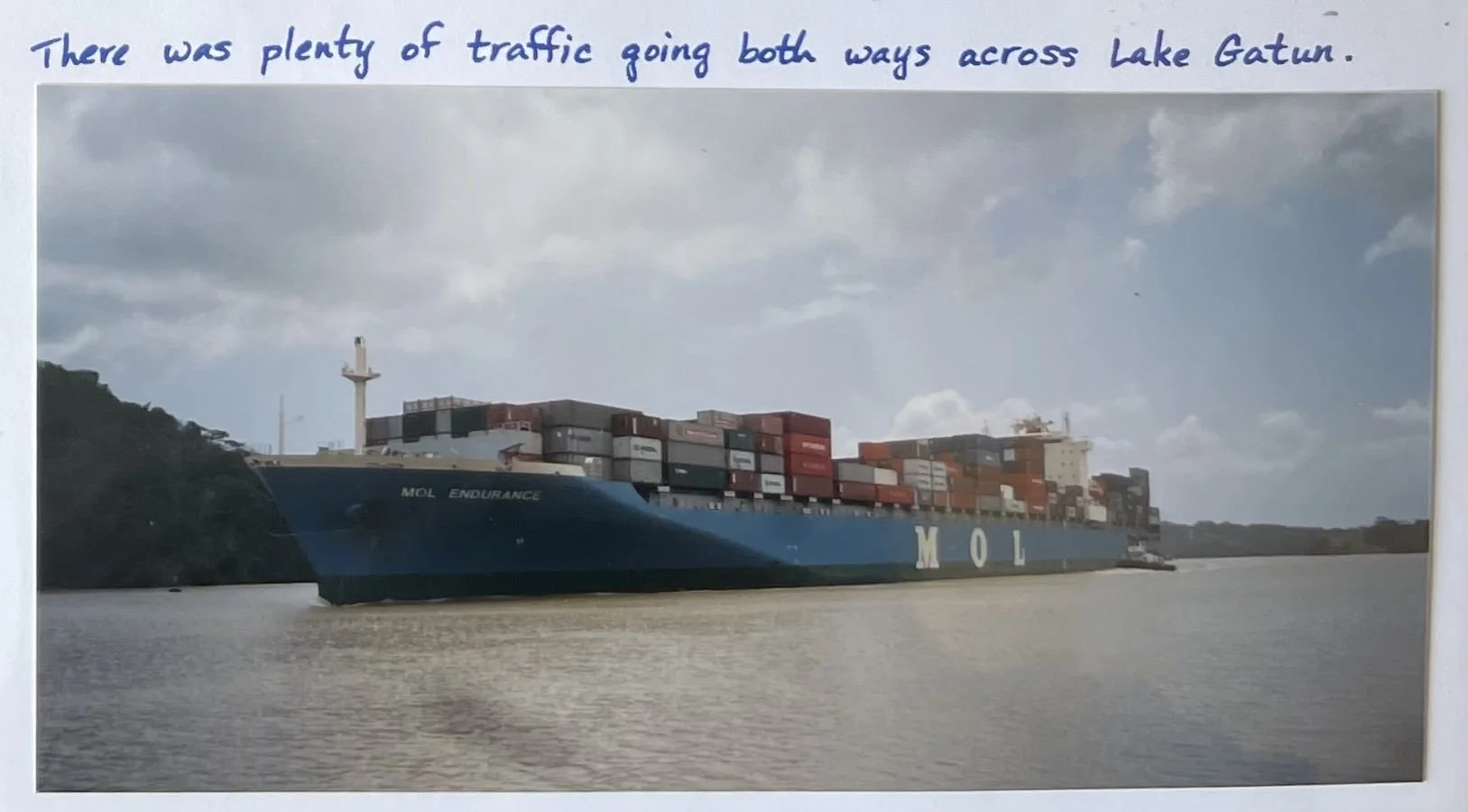
Caption by Ginny, in the official trip scrapbook
We anchored, and Tioga arrived 30 minutes later and tied to a mooring ball. We swam (until a guard came and told us that wasn't allowed) and cleaned up from the day, then pulled up the anchor and rafted to Tioga for dinner.
As we were eating dinner, the wind gradually died so the boats were not being held off the mooring buoy. So now we had a huge metal buoy banging against the bows of the boats. We decided to move back to the anchoring field, which we did still rafted together. Tioga put down an anchor, and we thought we were set for the night. But the wind came up and we decided we should unraft the boats. Since Tioga's anchor was already down, we unrafted, moved a short distance away and re anchored. Again, we thought we were set for the night. But the guard came back and yelled at us for having moved out of the anchoring field where our advisor had left us.
Since Tioga was now in the spot where our advisor had left us, the anchoring area was not well marked, the guard was not clear about where we should go, and the whole area was too deep for small boats anyway, we weren't really sure where to go. So we went to the other side of Tioga, anchored, and went to bed, hoping not to hear from the guard again.
The next morning I got up early and sat on the deck, listening to the birds and howler monkeys in the trees. After a relaxed start to the day, a different advisor arrived at 11:00, and we set off for the Gatun Locks.
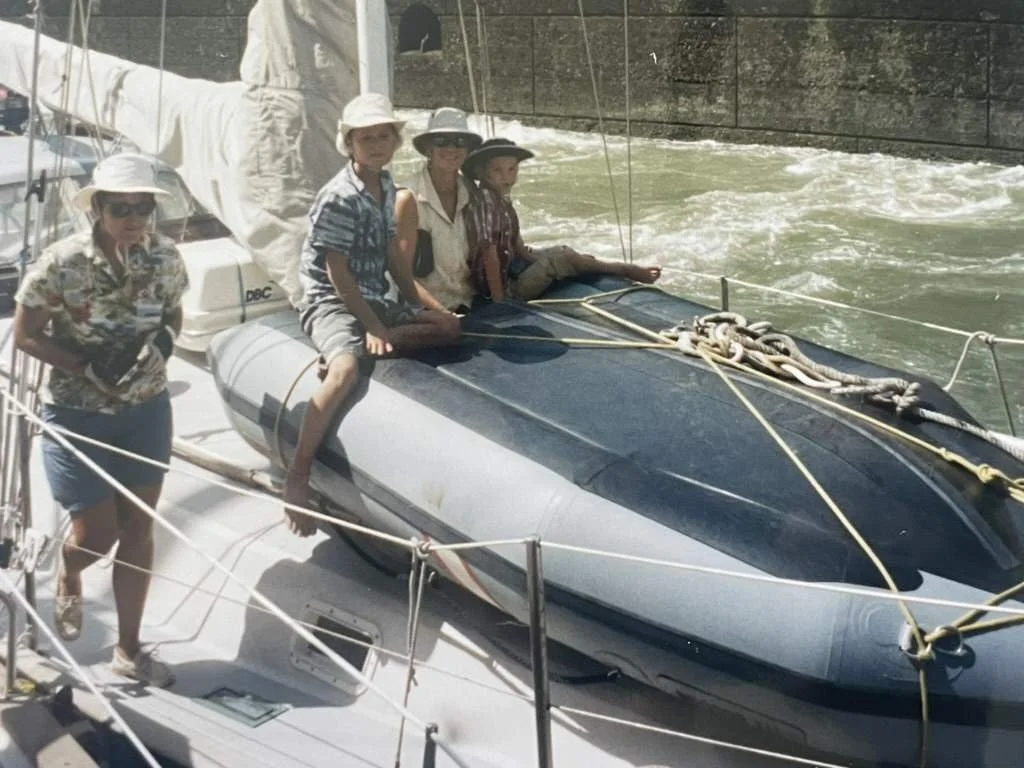
Rafting is when one boat ties up to another boat
Just outside the locks, we again rafted to Tioga. I was at the helm this time, and our advisor stood at my shoulder, calling directions to me and to Chris, who was on Tioga's helm. Because ours is the bigger engine, Atalanta was providing most of the power with some steering assist from Tioga when necessary.
This time we were to go center chamber (not rafted to a larger boat which was tied to the wall), so our line handlers got ready. Lines from our starboard side and from Tioga's port side were taken up to the top of the wall. As soon as we were set, a container ship entered the lock behind us. Exciting, but thankfully uneventful.
As the water level fell in the locks, the line handlers played out the lines. The two sides had to work together to keep our boats centered in the lock. The Gatun Locks has three steps going down. Every time a ship moves down from Gatun Lake to sea level, 26 million gallons of fresh water meet the salt water of the Caribbean. This creates turbulence when the last set of lock gates is opened, but we motored out without incident.
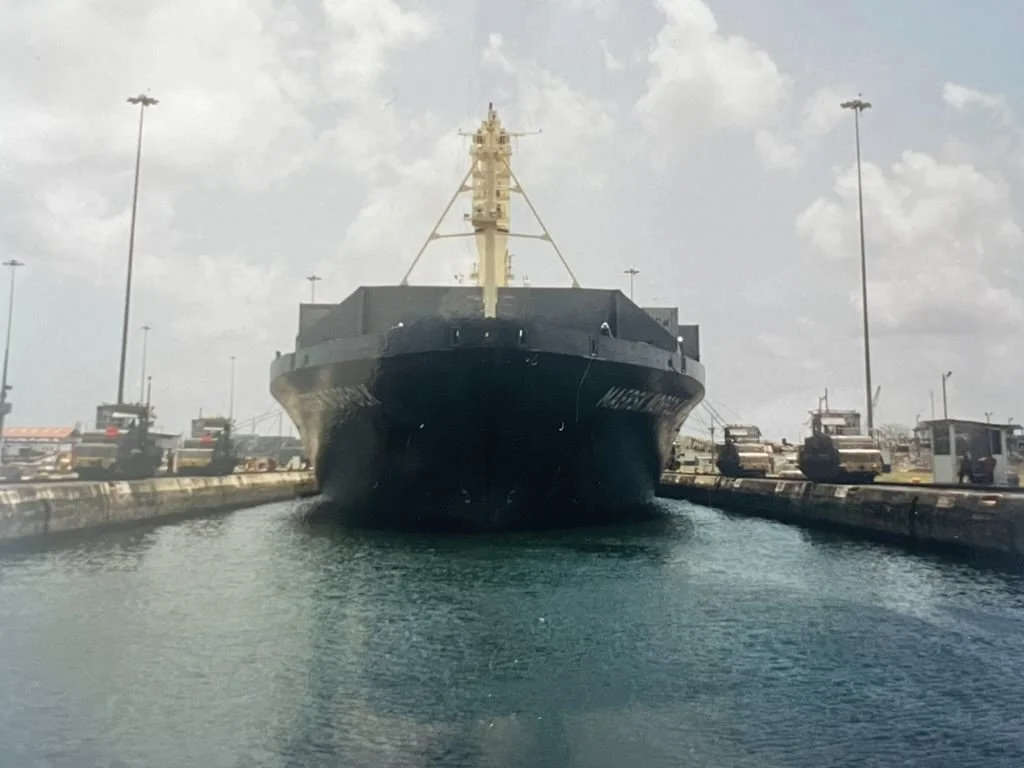
It will not shock you to learn that container ships are very large, and a 43-foot sailboat is not
Well clear of the gates and the oncoming container ship, we unrafted the boats and set off for the Panama Canal Yacht Club, Colon. We weren't planning to stay at the yacht club, but we went to the docks there to drop off our advisor, our crew, and the lines and tires we had used during the transit.
As soon as we got close to the yacht club, we were surrounded by dinghies asking for tires. All the small boats use tires wrapped in heavy plastic as fenders during the transit, and we were very glad we had so many when we were rafted to the tourist ship, which had no fenders of any kind. So we easily got rid of the tires to boats planning a transit the other way.
We dropped off our excellent crew with instructions about where to return the lines, and we heard later via email that Mike and Heather had dropped off the lines without incident. We returned to the anchoring area, got our anchor set, breathed a sigh of relief, and congratulated ourselves for having made it to the Caribbean!