
A Visit to Maximón
Part of sailing is record-keeping. And during our four years living aboard the good ship Atalanta, part of our records (in addition to our day-to-day ship’s logs) were the long and detailed emails that Ginny periodically sent to landlubbing friends and family to keep them up to date on this strange endeavor of ours.
Here is an excerpt of one of them, from February 7, 2004. This is actually a van update, not a sailing update—we (and our friends from S/V Tioga) left our boats at the coast and headed inland together in a van for a side trip.
But first, a few notes:
From Ginny’s original email: First a note on spelling: many of the place names are correctly written with accent marks over different letters, but I don't know how to do that on this keyboard. I apologize, therefore, for the imprecise spellings of many names.
Throughout this excerpt, you will see the term “Mayan” used several times. This is actually incorrect. The term should be “Maya” for referring to the people, the cities, the deities, etc; “Mayan” refers only to the languages. For more information on this distinction, see here or here.
We’re leaving the above in to maintain the authenticity of the excerpt, delivering it here as it was delivered all those years ago.
The “x” is pronounced “sh,” so Maximón’s name is pronounced “Mashimon.” The accent mark over the “o” indicates a stressed syllable.
Feb 7: Panajachel
It turned out that our guide from the first day, Mario, was a tour boat operator. By helping people find hotels, he is then able to solicit their business for a boat ride to the towns around Lake Atitlan. It sounded better than driving our van around the lake to get there ourselves, so we had signed up. Today was the day, and we awoke to high winds. We were concerned about the conditions on the very large lake, but were reassured that it would be fine. Of course he would say that.
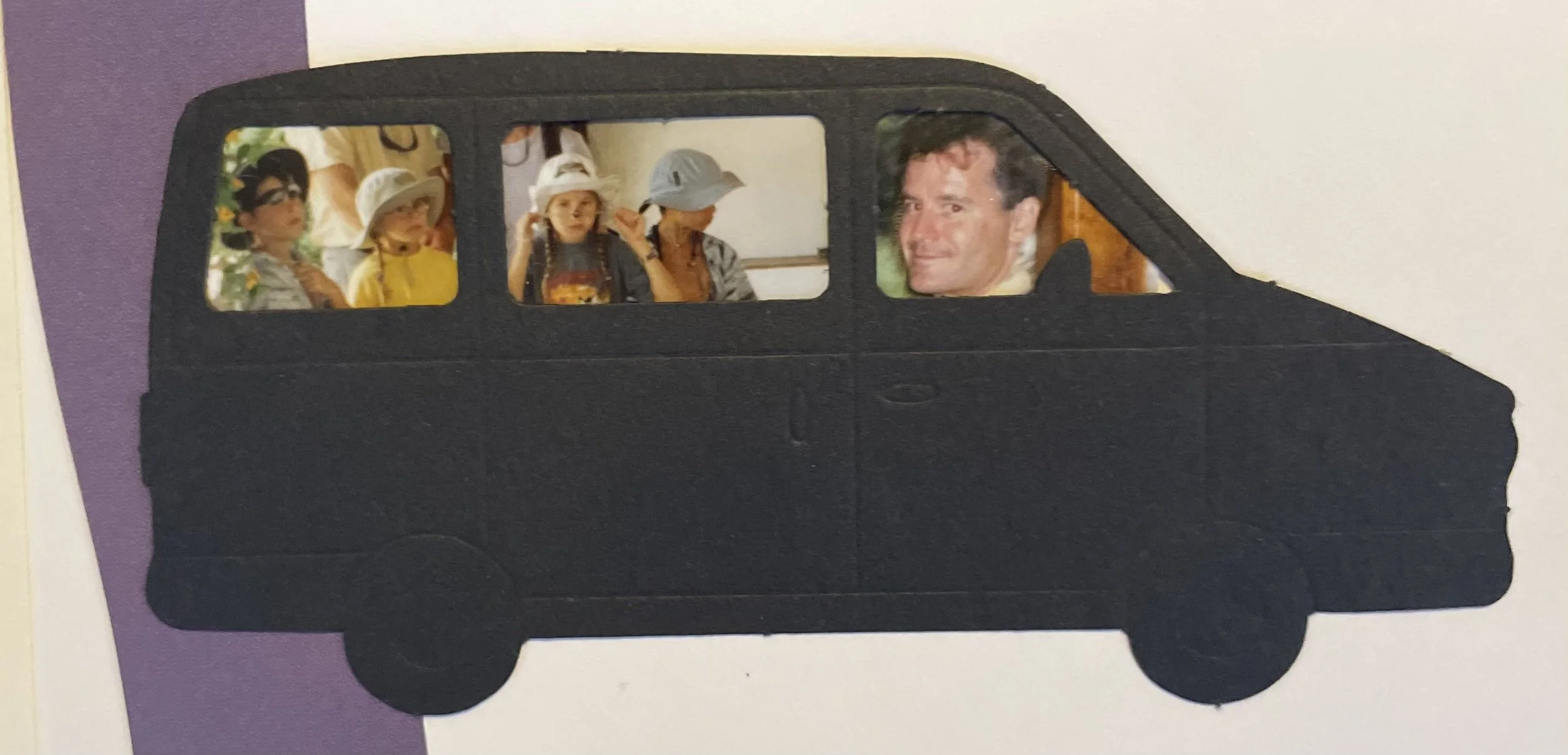
Not pictured: three other adults and a bunch of luggage also piled into the van
We set off downwind across the lake to the town of Santiago Atitlan, known to be a center for the worship of Maximon, a cigarette smoking, booze swilling god who is a strange combination of Mayan gods, Pedro de Alvarado (the conquistador of Guatemala), and the Biblical Judas.
We were told by our guide that really Maximon is mostly for the tourists these days, but someone else told us that the people go to church during the day, but at night they come to ask favors of Maximon. The figure of Maximon, carved out of wood and theoretically 2000 years old, is set up in a private home. This rotates on a yearly basis, Maximon changing houses during Semana Santa, the Holy Week leading up to Easter. The man of the household is the head of the religious council during that year. He doesn't work. His job is to sit with Maximon and receive offerings.
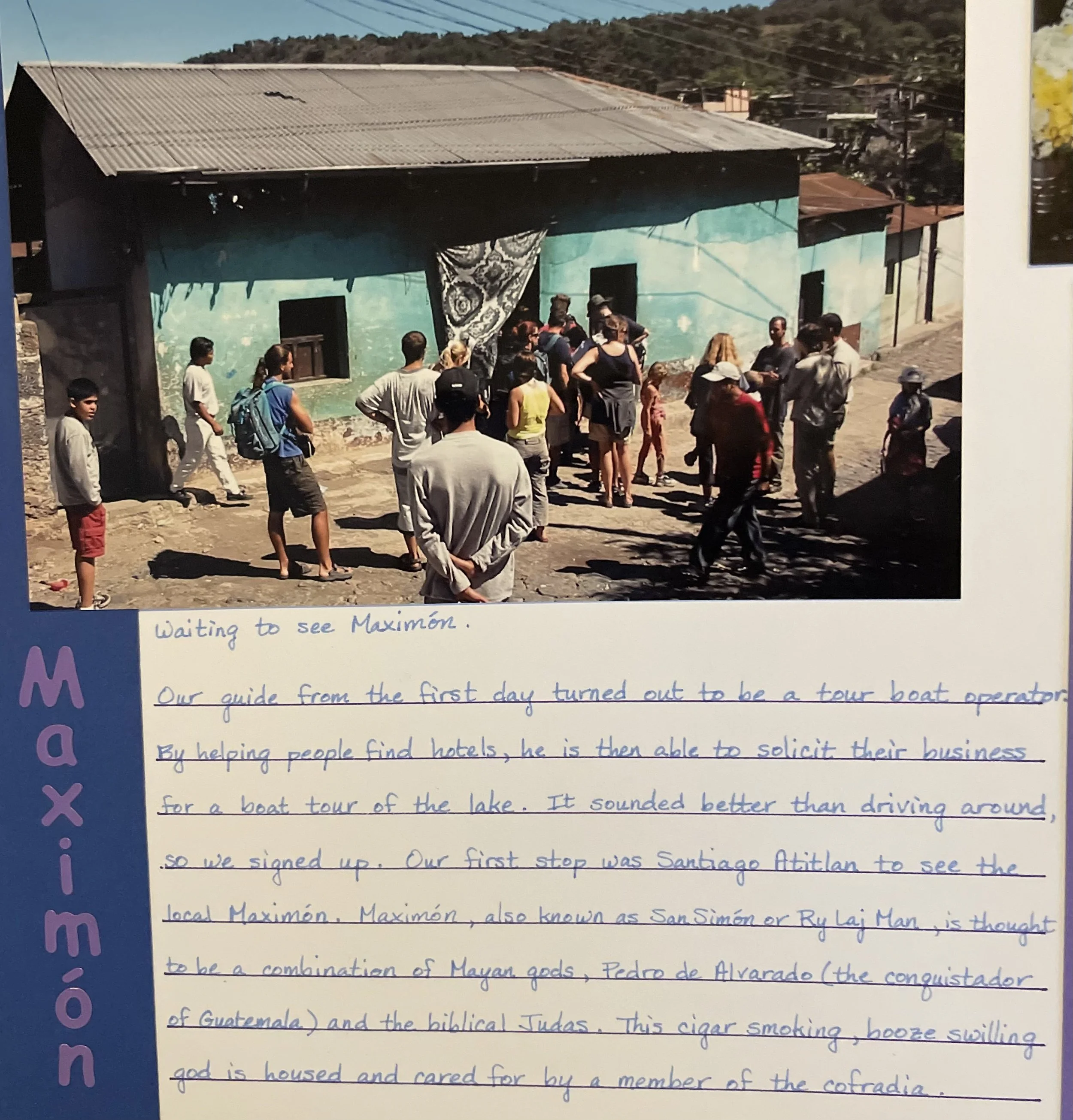
A page from Ginny’s scrapbook, saying what you just read in the beginning of this post, but in her nice handwriting
If Maximon is just for the tourists, he was surprisingly difficult to find. A local guide, recommended by our boat driver, led us through the narrow twisting streets and up several hills. In an unremarkable house, behind a green curtain hung in the doorway, was the dim, candle-lit room of Maximon. At first we were told the kids weren't allowed in, but when other kids, arriving with a different guide, went in, our guide relented.
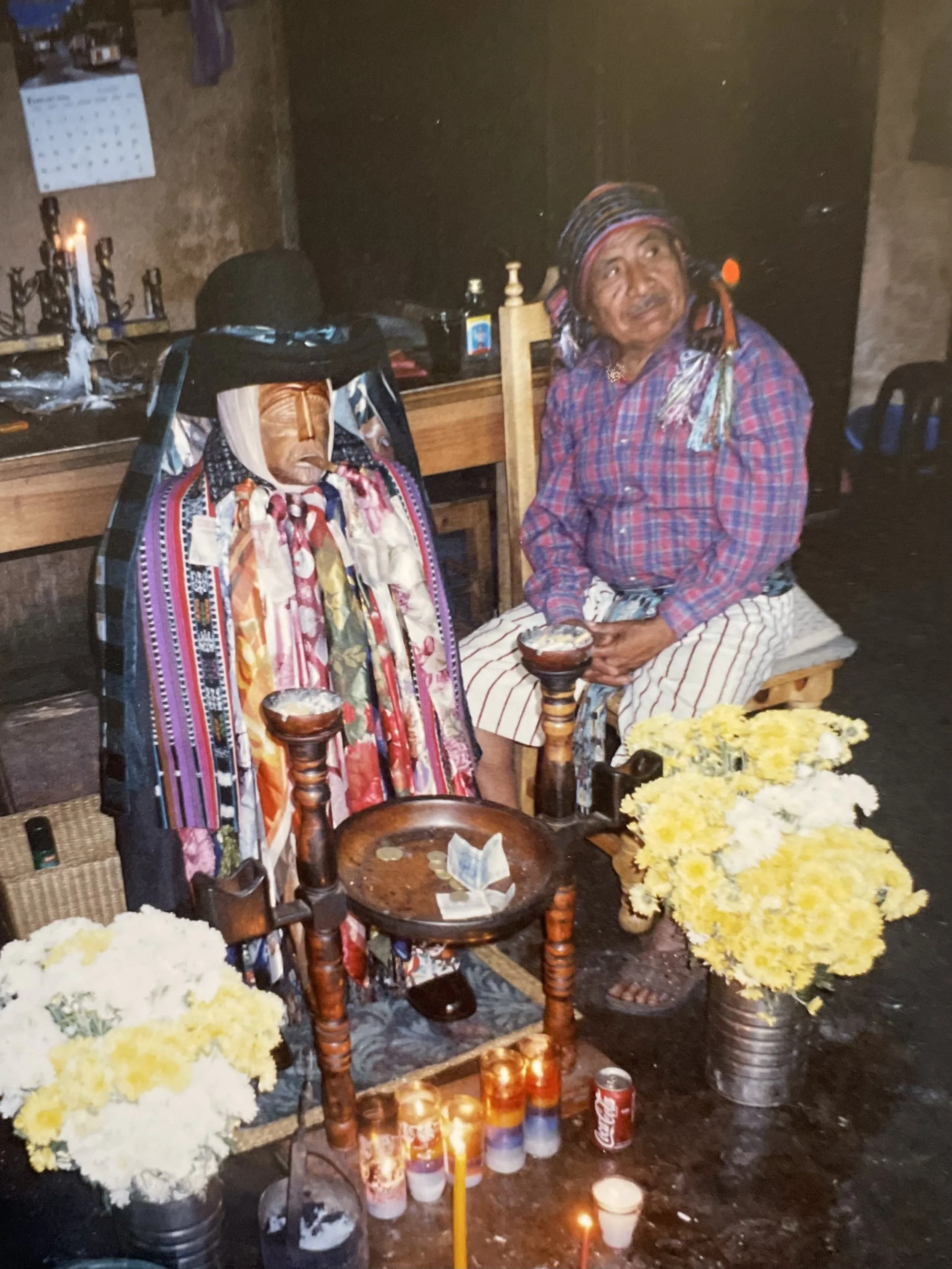
Maximón and one of his companions
The 3 foot high, wooden figure of Maximon, complete with a wooden cigarette in his mouth, was in the center of the room, draped with scarves, surrounded by candles and flanked by 2 men of the cofradia, the religious council. At one end of the room were 3 statues of different manifestations of the Virgin, and at the other was a typically gory statue of Jesus after being removed from the cross. In order to take pictures, we left an offering of a can of Coke and some money. Maximon's shirt front was stuffed with money, so he was having a good day.
After this somewhat strange experience, we went to see the other center of religious activity in town, the Catholic church. The Catholic church is apparently quite tolerant of the traditional Mayan religion, and the majority of the Mayan population embraces both religions.
The Mayan corn god appears on the carvings behind the main alter, and on the pulpit is a carved quetzal bird conversing with God. In niches all along the walls are statues of the saints. These were dressed in colorful hand-made clothes and draped with scarves. Their outfits are changed every year, during Semana Santa.
At the back of the church was a powerful memorial to the local people who were killed or disappeared during the civil war. In this town, a large group of unarmed farmers were shot down when they approached the local army headquarters to protest mistreatment of the local women by the soldiers, the pastor of the church was murdered in the rectory, and many of the people slept in the church every night to try to find safety. The peace accord was finally signed on Dec. 29, 1996.
Next was a very wet, upwind ride to the town of Santa Catarina. We were immediately besieged by girls trying to sell us things. We insisted we had to have lunch first and were ushered to a near-by restaurant.
We were approached several times during lunch by child salespeople, all with the same sing-song, almost Italian sounding, sales pitch. "Compra algo, buen precio, fue primero." (Buy something, good price, I was first.) After lunch I did buy some woven hair scrunchies from a girl named Anna, who had indeed been there first.
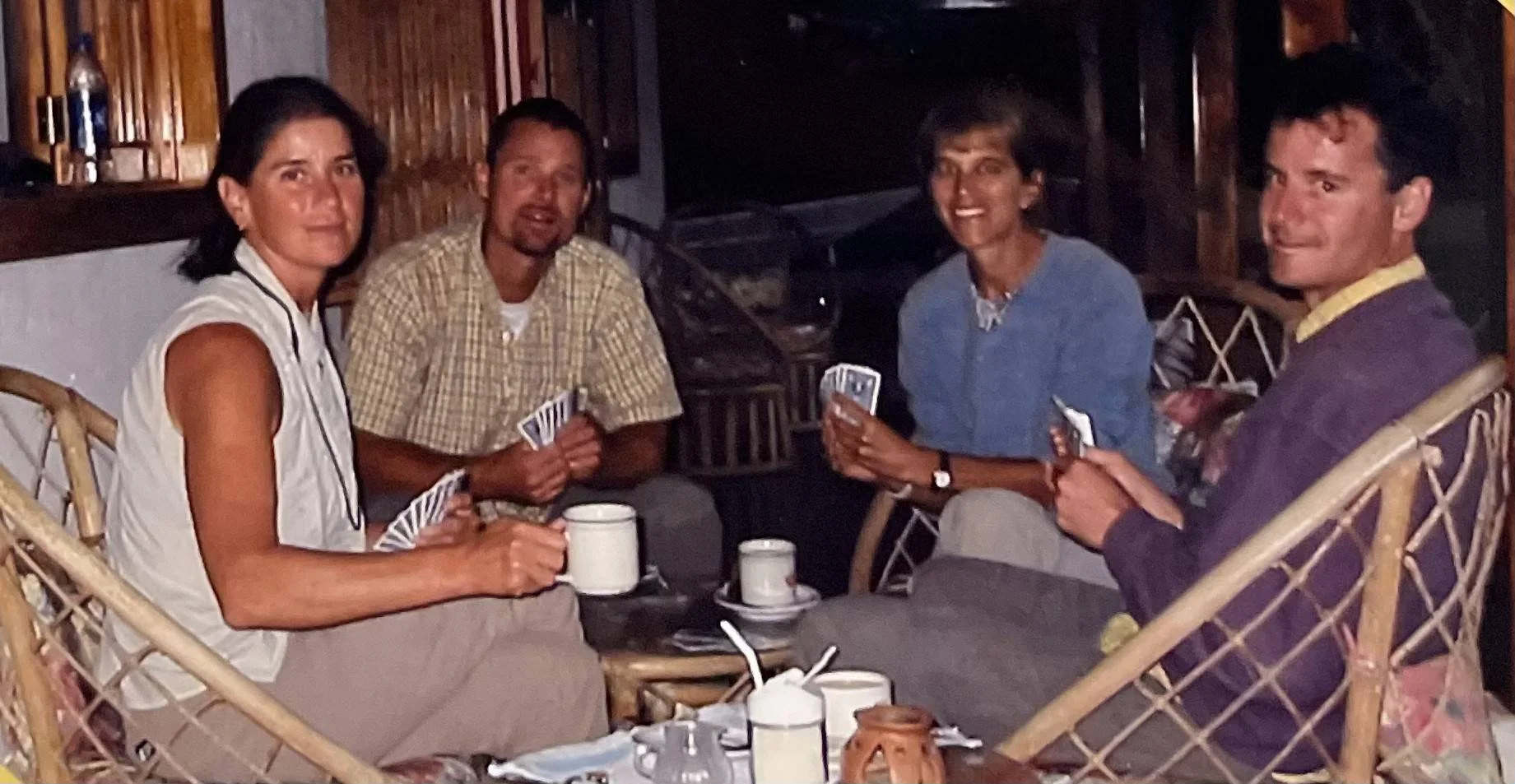
Sheila and Chris (of Tioga) with Ginny and Michael (of Atalanta)
We walked up to the unremarkable church, passing a large new hotel, not in the guide book. This town was listed as a small, off the tourist path, observe village life type of place, but no more! We were dogged every step of the way. Sheila and I each bought woven table runners on the way back. I bought mine from a girl named Nicolasa. She was working on another one while we were talking. She is 13 years old, goes to school in the mornings and weaves in the afternoons. I liked her work, and I liked that she had a value in mind for her work and was not very willing to bargain down. I wish now that I had bought more because we didn't find more of the same quality.
Our last stop in Santa Catarina was a hot spring where we were hoping to swim. We set off around the beach in the indicated direction. When we got there, we found a trickle of hot water coming out of the rocks directly into the lake and 2 women washing clothes. They laughed at us when we asked if the kids could swim there, so that was the end of that plan.
On the way back to our boat, we passed some cute kids whom I wanted to photograph. Being the well-read tourists that we are, we did the required thing and asked for permission first. Even the youngest piped up asking for quetzals, the Guatemalan money. Since I didn't have any coins left, I offered them pretzels instead, and that worked just as well. "No quetzales, solo pretzales!"
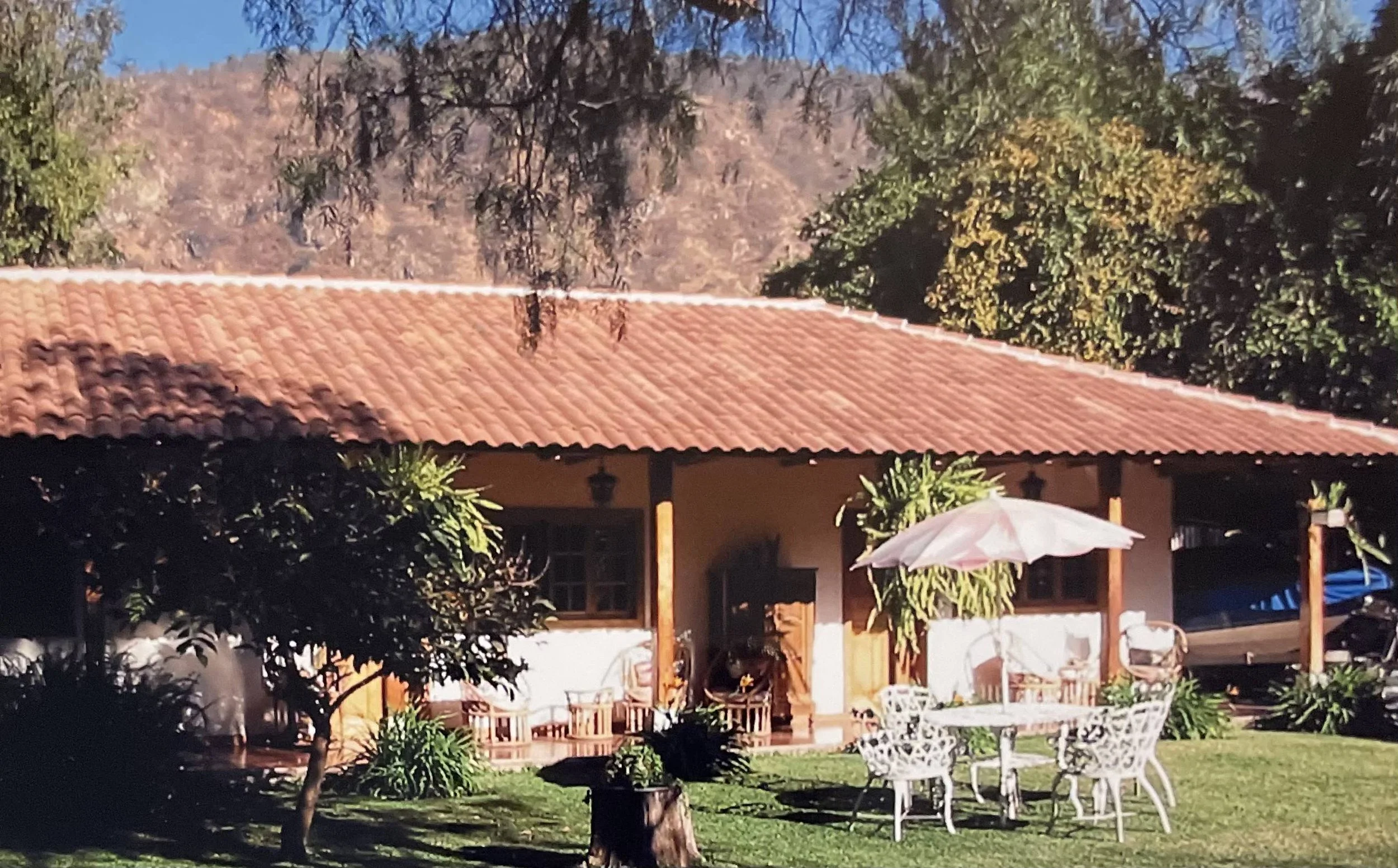
Muller’s Guest House, a lovely place to stay for a few days
Back to the tranquility of Mullers Guest House and our afternoon tea and game of Hearts. We branched out to try a different but equally good restaurant for dinner.
A sneak peek, since you made it to the end of a long post: in March 2004, we went through the Panama Canal from Pacific to Atlantic. More on that coming soon…